
AI Platforms AI release assurance for support and service teams Built for policy-sensitive support workflows

Turn every agent change into a testable, reviewable, release-ready workflow

Run policy, regression, privacy, and adversarial checks for support agents in ecommerce, fintech, healthcare-adjacent, and other high-stakes workflows. Connect your helpdesk, knowledge base, and CI pipeline, assign owners, approve releases with evidence, and turn production incidents into permanent regression coverage.

AI PlatformSupport Agent QAEcommerce FocusCI/CD ReadyHelpdesk ConnectedAudit-Friendly ReportsImplementation PlaybooksRole-Based Approvalsproduct fit Days to first release gateFaster rollout with guided implementationAgents, environments, and evaluationsPackaging that scales with usageTickets, transcripts, and release changesInputs converted into test coverage
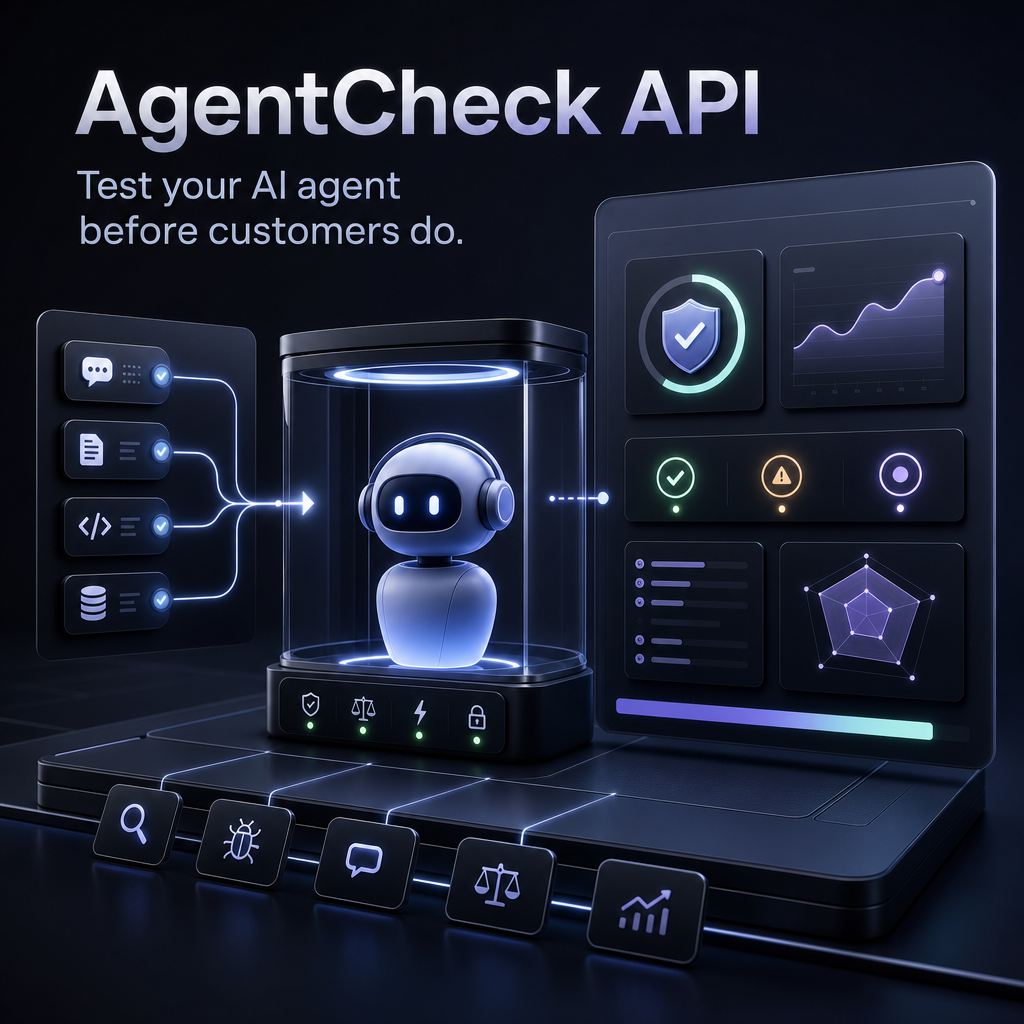
AgentCheck API product artwork
Product details

What it does

AgentCheck API helps teams test customer-facing AI agents before every release and after every change. Built for support, ecommerce, fintech, healthcare-adjacent, and other policy-sensitive workflows, it checks whether an agent follows refund rules, escalation paths, privacy requirements, regulated-topic guidance, and brand-safe support behavior. Teams can run prebuilt industry test libraries, generate policy-grounded scenarios from their own documents, compare results across prompts and models, and turn real production incidents into repeatable regression tests. With API access, CI-ready workflows, audit-friendly reporting, maintained scenario packs, implementation playbooks, onboarding templates, role-based approvals, and strong ecommerce support coverage, AgentCheck API makes agent QA part of the release pipeline instead of a manual checklist.

CategoryAI Platforms
Pricing modelStarts at $49/month with plans that scale by agents, environments, scenario libraries, evaluations, audit retention, and workflow governance needs.
Best forSupport-platform teams, ecommerce operations, fintech support leaders, healthcare-adjacent service teams, product managers, QA leads, compliance stakeholders, and developers responsible for customer-facing AI agents.
Feature set

Key product features

API-driven test execution for customer-facing AI agents

Prebuilt vertical libraries for ecommerce, fintech, healthcare-adjacent, and policy-sensitive support workflows

Dedicated ecommerce scenario packs for refunds, returns, exchanges, delivery issues, promotions, subscriptions, and fraud-sensitive support flows

Policy-grounded test generation from refund rules, privacy policies, escalation paths, support macros, and knowledge-base content

Regression testing after prompt, model, policy, macro, integration, or knowledge-base changes

Checks for hallucinations, privacy leaks, unsafe actions, prompt injection, prohibited claims, and broken escalation logic

Audit-friendly release reports with scenario evidence, run history, and policy-linked outcomes

CI/CD and helpdesk workflow integration support

Scenario-based adversarial tests for refund abuse, escalation failures, verification gaps, and edge cases

Team dashboard with run history, comparisons, environment tracking, and recurring failure trends

Production incident import from tickets, transcripts, and flagged conversations to create permanent regression tests

Custom rule packs by workflow, region, and brand policy

Multilingual support test coverage for global service teams

Release risk reporting with recurring failure classes, policy adherence trends, and model or prompt comparison views

Implementation playbooks with setup steps, launch checklists, and rollout milestones

Onboarding template library for support teams with ready-made forms, tasks, alerts, and dashboards

Role-based permissions, owner assignment, approvals, private notes, and manager visibility

Savings estimator for avoided support errors, faster release reviews, and reduced manual QA effort

Narrow to the highest-value buyer segment

Use cases

Where it helps

Block risky support-bot releases before they reach customers

Verify an agent follows refund, returns, and exception policies in ecommerce

Test privacy and regulated-topic guardrails for fintech and healthcare-adjacent support

Run checks automatically after prompt, model, policy, macro, integration, or knowledge-base updates

Turn real support failures into regression tests so issues do not return

Give product, support, operations, and compliance teams a shared release artifact

Validate escalation behavior when an agent should hand off to a human

Compare agent performance across staging and production environments

Measure recurring failure patterns across agents, environments, and release cycles

Review imported incidents from helpdesk tickets and transcripts to strengthen future releases

Launch a new QA process with guided templates instead of building workflows from scratch

Assign release owners, approve exceptions, and manage signoff across distributed teams

What it solves

Built for the real risks in customer support AI

Most teams test whether an agent can answer. AgentCheck API tests whether it answers safely, follows policy, escalates correctly, and stays consistent after every change.

Catch regressions before release Compare behavior across prompts, models, policies, macros, and knowledge-base updates so changes do not quietly introduce new support risks.

Own the highest-risk ecommerce workflows Start with scenario libraries tailored to refunds, returns, exchanges, order exceptions, payment issues, and subscription support where mistakes are costly and visible.

Generate tests from your own rules Upload refund policies, support macros, escalation paths, and prohibited claims to create policy-grounded scenarios with clear assertions.

Give every team clear evidence Share audit-friendly reports, recurring failure trends, and release summaries with product, support, operations, and compliance stakeholders.

How it fits your workflow

From support change to release gate

AgentCheck API is designed to become part of your deployment process, not another dashboard teams forget to check.

Trigger on every change Run tests automatically when prompts, policies, models, integrations, macros, or knowledge-base content change.

Connect to helpdesk and knowledge systems Bring testing into support platforms, ticketing tools, chat systems, and knowledge bases so operational changes and agent checks stay aligned.

Approve staging before production Compare environments, review failures, assign owners, and hold customer-facing releases until policy-critical issues are resolved.

Learn from live incidents Import tickets, transcripts, and flagged conversations, assign severity and ownership, and convert real failures into permanent regression scenarios.

Core capabilities

More than generic LLM evaluation

AgentCheck API focuses on customer-facing service quality, policy adherence, and repeatable release assurance.

Adversarial support scenarios Probe for refund abuse attempts, prompt injection, policy conflict, sensitive-data exposure, and escalation breakdowns.

Vertical policy libraries Start with scenario packs tailored to ecommerce support, fintech service operations, and healthcare-adjacent interactions.

Policy-grounded assertions Tie test outcomes to your documented rules so teams can see exactly where an agent followed or violated guidance.

Trend and risk reporting Track recurring failure classes, policy compliance patterns, prevented repeat incidents, and model or prompt comparison outcomes over time.

Platform companion

Turn support incidents into stronger future releases

AgentCheck API does not stop at pre-release testing. It helps teams capture what happened in production and feed it back into the next release cycle.

Import from tickets and transcripts Bring in helpdesk tickets, chat transcripts, and escalations that reveal where the agent missed policy or failed to hand off correctly.

Create permanent regression scenarios Convert real incidents into reusable tests with owner, severity, and historical outcomes so the same issue is less likely to return.

Track issue history by environment See whether a problem is isolated to staging, production, a specific prompt, or a model change before the next rollout.

Share actionable review packs Give support, QA, product, and compliance teams a single view of what changed, what was tested, and what needs attention.

Implementation made simple

Launch with a rollout plan your team can actually follow

Buyer confidence grows when implementation feels clear. AgentCheck API includes practical rollout guidance so teams can move from trial to release process quickly.

Step-by-step implementation playbook Follow setup guidance for agents, environments, policy uploads, approval rules, release gates, and recurring test schedules.

Onboarding templates for support teams Start from ready-made forms, task lists, team messages, dashboard views, and workflow presets built for support operations.

Ownership and permissions built in Assign reviewers, control access by role, keep private notes internal, and give managers a clear signoff path before launch.

Success milestones from week one Track time to first test suite, first policy pack, first incident import, and first gated release with measurable rollout checkpoints.

Packaging that grows with you

Start small, then expand coverage as AI support becomes mission-critical

Plans are designed around the way teams grow: more agents, more release environments, more evaluations, longer audit retention, and tighter team governance.

Scale by agent and environment Add customer-facing bots, brands, regions, and staging or production environments without rebuilding your QA process.

Increase evaluation depth over time Expand from basic smoke tests to policy libraries, adversarial scenarios, multilingual coverage, and ongoing regression packs.

Match retention to review needs Keep the right level of run history, evidence, and audit context for operational reviews, quality programs, and policy traceability.

Show payoff with savings estimates Use built-in value framing to quantify avoided errors, reduced manual QA time, and faster release reviews for stakeholder buy-in.

Pricing

Commercial packaging

Editable pricing cards exported directly in the product catalog JSON.

Starter

$49/mo

For smaller teams validating early support agents and basic release checks.

  • Core API access
  • Starter vertical scenario packs
  • 1 agent and 1 environment included
  • Monthly evaluation allowance
  • Manual policy uploads
  • Basic run history
  • Email support
  • Quick-start implementation checklist
Request pricing
Recommended

Team

$499/mo

For product and support teams that need automated release gates and policy-based testing.

  • Everything in Starter
  • More agents and release environments
  • Expanded monthly evaluations
  • Regression comparisons across prompts and models
  • CI/CD and helpdesk workflow integration
  • Policy-grounded test generation
  • Release reports with scenario evidence
  • Imported incident-to-regression workflow
  • Role-based approvals and ownership
  • Onboarding templates and rollout playbooks
  • Priority support
Request pricing

Enterprise

Custom

For multi-agent environments with custom policies, retention requirements, and higher-volume evaluations.

  • Pricing by agents, environments, evaluations, and retention
  • Custom policy packs and scenario libraries
  • Dedicated ecommerce, fintech, or healthcare-adjacent workflows
  • Production incident import at scale
  • Advanced trend and risk reporting
  • Extended audit retention
  • Dedicated onboarding and support
  • Custom integrations for helpdesk, knowledge, and service operations
  • Manager-level controls, permissions, and review flows
  • Value modeling for rollout and expansion planning
Request pricing
FAQ

Buyer questions

Who is AgentCheck API built for?

It is designed for teams running customer-facing AI agents, especially in support and service workflows where policy mistakes, privacy issues, or unsafe responses can create real operational problems.

Why is ecommerce a strong fit?

Ecommerce teams often manage high volumes of refunds, returns, exchanges, delivery issues, subscription questions, and promotion edge cases. AgentCheck API includes scenario packs built for these support workflows so teams can test common risks before changes reach customers.

Can we test changes after prompt or knowledge-base updates?

Yes. AgentCheck API supports regression testing after prompt, model, policy, macro, integration, and knowledge-base changes so teams can compare outcomes before release.

Do you provide prebuilt test libraries?

Yes. The platform includes maintained scenario libraries for policy-sensitive support workflows, with vertical packs for ecommerce, fintech, healthcare-adjacent, and other service use cases.

Can we use our own policies and support rules?

Yes. Teams can upload refund policies, escalation rules, support macros, privacy guidance, and prohibited claims to generate policy-grounded tests and clearer assertions.

Does it work only through a dashboard?

No. Teams can use the dashboard, API, and CI-ready workflows so testing can run automatically as part of their release process. It is built to connect with support operations, not sit beside them.

Can it learn from production incidents?

Yes. Teams can import flagged tickets, transcripts, and failure patterns to create new regression tests with ownership, severity, and historical outcomes, helping prevent repeat issues in future releases.

How does pricing scale as we grow?

Plans expand as teams add more agents, test more environments, run more evaluations, retain more release history, and introduce tighter team controls. This makes it easy to start small and expand coverage as support AI becomes more business-critical.

How quickly can a team get started?

Most teams begin with a guided rollout using implementation playbooks, onboarding templates, and a starter release-gate workflow. That makes it easier to move from initial setup to a live testing process without building everything from scratch.

Can multiple teams review and approve releases together?

Yes. AgentCheck API supports role-based permissions, assignment ownership, private notes, and manager visibility so product, QA, support, and compliance teams can coordinate reviews with clear accountability.

How do you help buyers show business value internally?

The platform includes value framing around avoided support errors, reduced manual QA effort, faster review cycles, and fewer repeat incidents so teams can explain the payoff of stronger release assurance.

Next step

See how AgentCheck API fits your release workflow

Talk through your support stack, policy requirements, and rollout plan. We will show how to connect change events, automate tests, assign owners, and launch a practical release gate for customer-facing AI agents.